

Realpolitik Abroad, Repression at Home
The wars in the Gaza Strip and Sudan, along with the collapse of the Assad regime in Syria, are having a profound impact on regional developments. In the Israeli-Palestinian conflict, in particular, regional power players have turned to a pragmatic, realpolitik approach. Domestically, however, governments continue to rule with an iron grip – even in countries where the Arab Spring’s influence lasted longest. One of the BTI 2026’s few positive surprises is Iraq, which shows signs of increasing stability.
Hamas’ attack on Israel on October 7, 2023, and the ensuing war in the Gaza Strip profoundly shaped the Middle East and North Africa during the BTI review period (February 2023 to January 2025). Beyond the shock and devastation on both sides, the responses of key regional powers – notably, Egypt, Jordan, Qatar and Saudi Arabia – signaled a dramatic realignment. While domestic hard-liners continue to govern with an iron grip, many governments are showing unexpected flexibility abroad, increasingly prioritizing pragmatic cost-benefit calculations over rigid ideological positions. Once unthinkable, cooperation with Israel has become largely normalized, and the Abraham Accords, brokered by the United States in 2020, have now withstood their first major stress test.
At the same time, Israeli strikes against Iran and its regional proxies, including Hezbollah in Lebanon and the Houthi rebels in Yemen, have significantly eroded Tehran’s influence. Meanwhile, Syria, which has emerged as the BTI 2026’s fastest improver following the fall of the Assad regime in December 2024, and Iraq, which is increasingly stable both economically and politically, appear to be gradually distancing themselves from Iran’s orbit.
In Sudan, the region’s other major theater of war, foreign involvement has taken a very different form. The conflict pits the Egypt-backed Sudanese Armed Forces (SAF) against the paramilitary Rapid Support Forces (RSF), heavily supported by the United Arab Emirates – with both sides also receiving assistance from Russia. The human toll has been catastrophic. According to UN estimates (August 2025), more than 50,000 people have been killed and over 14 million displaced since fighting erupted in April 2023, and millions more now face the threat of famine.
Political transformation
Between fragility and stabilization
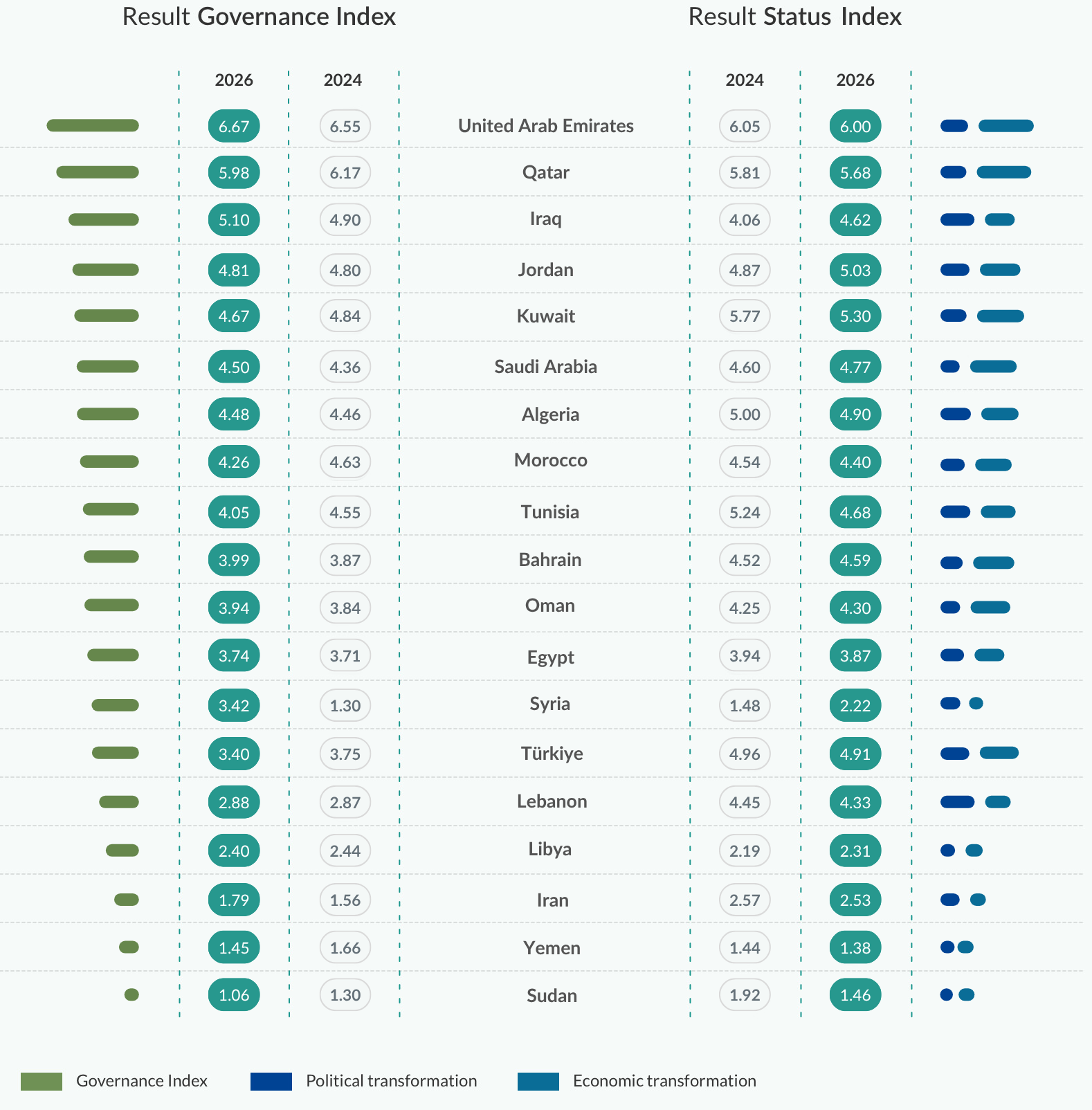
Sudan, alongside Libya and Yemen – all three effectively failing states – remains at the bottom of the political transformation scale. Syria also continues to face profound instability. Yet the unexpected power shift on December 8, 2024, has left a clear imprint on the BTI assessment: The collapse of the decades-old Baath regime and its replacement by the Islamist group Hay’at Tahrir al-Sham (HTS) led to measurable improvements in eight of the 18 indicators within the political transformation index, most notably in freedoms of association, assembly and expression. Still, this cannot be mistaken for a genuine democratic opening. HTS shows only limited commitment to the rule of law, a reality underscored by its refusal to grant access to its detention facilities in Idlib, in stark contrast to the documented closure of Assad’s infamous torture prisons. The road ahead for Syria is daunting. The country must rebuild state institutions, draft a new constitution, and create credible prospects for the return of refugees and internally displaced persons. This creates fertile ground for social unrest in a society where, according to UN estimates, nearly 90% of the population now lives below the poverty line.
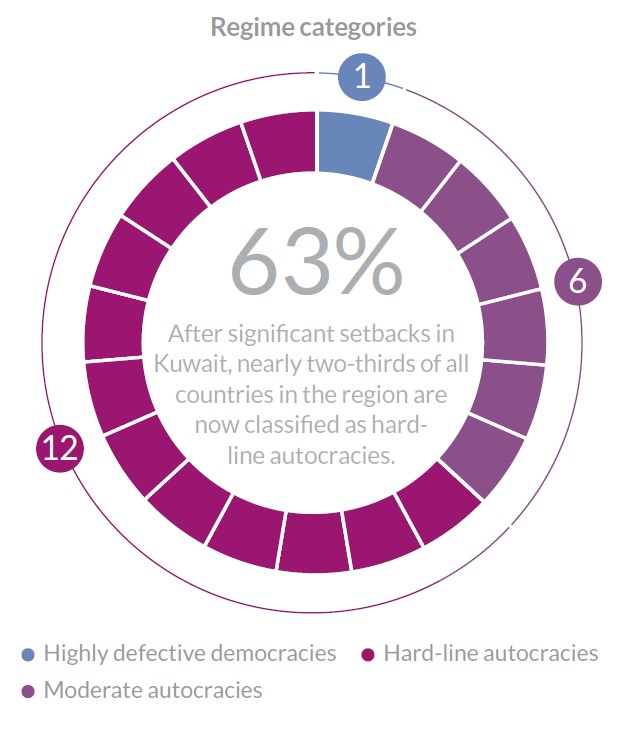
By contrast, Iraq has emerged as a rare source of guarded optimism. Under Prime Minister Mohammed Shia’ al-Sudani, the government has strengthened stability and security, thereby contributing to measurable gains in areas such as press freedom. This marks no small achievement considering that, only a few years ago, the Committee to Protect Journalists labeled Iraq “the deadliest country for journalists.” Yet meaningful democratization remains elusive, even as Iraq now ranks just behind Lebanon, the region’s only – albeit highly defective – democracy.
Kuwait’s recent political developments are cause for concern. For the first time in BTI history, the Gulf monarchy is no longer classified as a moderate but as a hard-line autocracy (–0.75 points). The shift follows the accession of Sheikh Meshal al-Ahmad al-Jaber, who assumed the throne on December 16, 2023, at age 83, after serving as crown prince. Since taking power, the emir has adopted a markedly more authoritarian governing style, most visibly in his confrontation with Kuwait’s National Assembly, which was long regarded as one of the most empowered legislative bodies in the Gulf. Following a protracted standoff, he dissolved the assembly by decree on May 10, 2024, declaring that new elections would not be held until after the adoption of an entirely revised constitution, which is unlikely to take place before 2028.
Tunisia represents another significant setback (–0.65 points). The October 2024 presidential elections, conducted under heavy repression, handed incumbent Kais Saied an implausible 90.7% of the vote – effectively marking the end of Tunisia’s experiment with democracy. Algeria has also seen hopes for reform fade. After briefly raising expectations for democratization and regime change in the wake of the 2019 protests, the country has largely reverted to pre-Arab Spring conditions, returning to roughly the level it had achieved in the BTI 2010. Sharp declines are particularly evident in freedoms of association and assembly, the separation of powers, and civil rights protections.
Economic transformation
The fortunate 2%
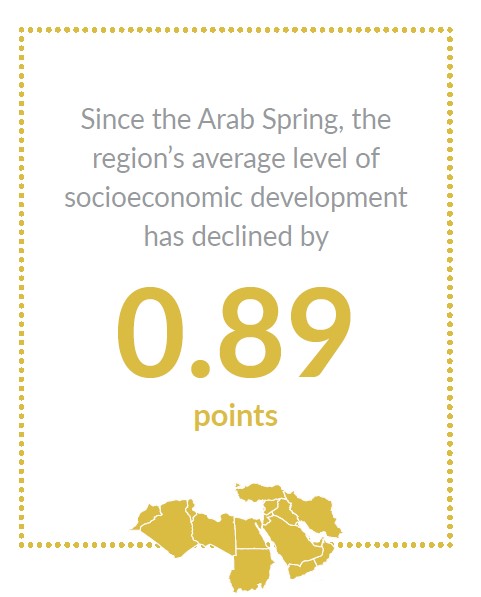
More than a decade after the Arab Spring, the harsh living conditions that helped ignite the 2010 uprisings remain largely unchanged across the region. To be sure, the United Arab Emirates and Qatar boast highly advanced or advanced market economies that are supported by extensive social safety nets. Yet, together, they only account for roughly 2% of the region’s total population. In stark contrast, roughly 60% of the region’s residents – or around 376 million people – live under severely constrained or even rudimentary economic and social systems, which has immediate consequences on their daily lives.
For example, developments in Egypt – which is by far the largest economy in the region, with over 114 million inhabitants – are worrying. With a record-low score of 4.32 in the BTI’s economic transformation dimension, the government of Abdel Fattah al-Sisi now ranks even below that of Hosni Mubarak during the kleptocratic twilight years of his rule. A gradual decoupling of the Egyptian pound from the U.S. dollar – a key demand of the International Monetary Fund – has triggered steep currency devaluations, driving annual inflation as high as 38% in 2023. Basic goods and medicines have become prohibitively expensive for large segments of the population and, according to the World Food Programme, about 15% of Egyptians now face food insecurity. While Tunisia’s situation is less severe, President Saied’s recent move to bring the central bank under his control raises concerns about future monetary policy and, with it, the cost of living.
The Iraqi dinar, on the other hand, has stabilized. A development fund targeting the country’s most disadvantaged provinces has been established, and the poverty rate fell to 17.6% in 2024. Yet deep vulnerabilities persist, as the economy remains overwhelmingly dependent on oil exports, while agriculture – contributing just 4% to GDP – is increasingly threatened by climate change. Intensifying heat waves and prolonged droughts are undermining the fertility of the “Mesopotamian breadbasket,” once the backbone of Iraq’s food security. Moreover, Iraq’s economic trajectory remains tightly linked to developments in neighboring Iran, which handles a significant share of its imports.
In Iran, however, there are increasing levels of poverty and inequality. Persistent inflation, which hovered around 40% during the review period, is the primary driver of these developments. Urgently needed expertise is all too often constrained by ideological orthodoxy in various policy areas, such as the economy, environment and education. Roughly one-third of Iranian researchers and scientists now work abroad, with few intending to return. This persistent brain drain mirrors dynamics in Sudan, the country recording the most severe economic setbacks during the review period (–0.50 points). The consequences of ongoing civil war in Sudan, which erupted in April 2023, have been devastating. Particularly in the contested regions, millions have lost their homes, businesses and livelihoods. While the informal economy has expanded rapidly, the destruction of educational infrastructure has left an estimated 17 million Sudanese children without access to formal schooling, according to UNICEF.
Governance
Insufficient integrity
Tunisia has shown mounting weaknesses under President Saied. Frequent cabinet reshuffles – including the dismissal of Prime Minister Najla Bouden Romdhane in August 2023 and her successor, Ahmed Hachani, just a year later – have led to erratic, short-term policymaking. Saied’s increasingly authoritarian trajectory has also reshaped Tunisia’s external relations. Engagement with the European Union now centers less on democratic reforms and more on strengthening migration control efforts. A symbolic turning point came on July 16, 2023, when European Commission delegation headed by Ursula von der Leyen met with Saied in Tunis. The visit effectively conferred legitimacy on his regime despite its growing autocratic drift, his inflammatory rhetoric on migration, and his dismissal of criticism from human rights bodies.
Governance shortcomings are also hindering development in Morocco. A complex bureaucracy, centralized decision-making and weak inter-agency coordination have delayed efforts to mitigate the environmental fallout of the Green Morocco Plan, which was originally intended to boost agricultural productivity. These structural issues have also hampered progress on much-needed reforms in education and healthcare policy.
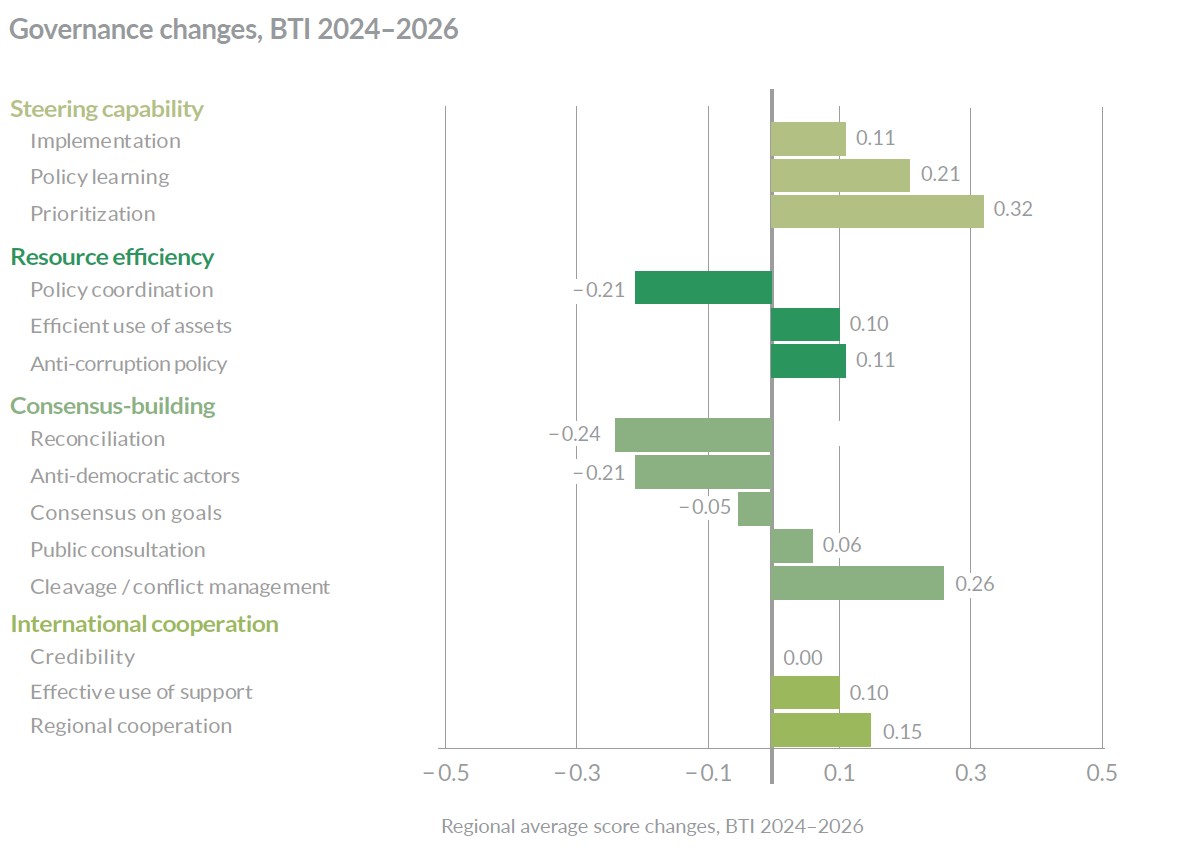
In addition, corruption remains a persistent challenge in Morocco, but the country is far from alone on this front, as many countries in the region face similar issues. Türkiye provides a particularly stark example of governance failure during the review period. The devastating earthquake of February 6, 2023, which struck the country’s southeast, killed more than 60,000 people and rendered over 230,000 buildings uninhabitable. According to experts, government negligence – including lax enforcement of building codes, the retroactive legalization of unsafe construction in exchange for fines, and chronic underinvestment in disaster preparedness – is partly to blame for the scale of the destruction. Nevertheless, despite widespread public anger, President Recep Tayyip Erdoğan narrowly secured reelection in 2023 – buoyed by generous preelection spending promises and legal pressure on his political rivals. His ruling AKP, however, suffered a historic defeat in the 2024 municipal elections, losing to the opposition Republican People’s Party (CHP) for the first time. Erdoğan responded by ordering the arrest of several victorious CHP politicians, including Istanbul’s mayor, Ekrem İmamoğlu, blatantly disregarding the democratic will of Turkish voters.
In sharp contrast, Saudi Arabia’s royal family appears to be succeeding in consolidating both domestic approval and international influence. Crown Prince Mohammed bin Salman, once globally isolated after the 2018 murder of journalist Jamal Khashoggi, has repositioned himself as a sought-after diplomatic partner for the United States, China and Russia alike. Even with its longtime rival Iran, Saudi Arabia pursued a rapprochement brokered by China, while a separate agreement with the Houthis brought an end to drone attacks on Saudi territory. Perhaps most notably, Riyadh managed a delicate balancing act during the Gaza war by voicing solidarity with Palestinian civilians without derailing its gradual normalization of ties with Israel. It was another milestone in the kingdom’s broader push to assert regional leadership.
Outlook
Flexibility and intransigence
Until the outbreak of the Iran War in February 2026, it appeared that the heavy blows Israel’s military had dealt Iran during the 12-Day War had, on the whole, created cautious openings for a less volatile regional future. Had the trajectory set by the Abraham Accords been continued, amicable flexibility could have emerged as the defining principle of Middle Eastern foreign policy. Even under such a scenario, however, sustainable democratization of the countries involved had been unlikely. For all their newfound flexibility in foreign affairs, the region’s autocratic regimes remain deeply uncompromising at home.
Meanwhile, the broader international community appears to have largely resigned itself to this status quo. Under Donald Trump, the United States has abandoned any pretense of moral leadership. The European Union has pursued ethically fraught migration deals designed to contain a crisis it helped to create through unbalanced trade practices, arms sales and inadequate climate action. At the same time, Russia and China are positioning themselves as appealing partners for regional strongmen, offering financial support and weapons – without uncomfortable demands for progress on human rights, gender equality and environmental protection. The catastrophic consequences of such partnerships are already on full display in Sudan. Against this backdrop, the growing influence of Russia across North Africa represents an especially troubling trend – one likely to further embolden the region’s hard-liners.